Pages

Showing posts with label natural environment. Show all posts

Sunday, May 11, 2014

Deadly Creatures: An Exercise in Point of View

Screen
Look long and hard, little scorpion... They're HUMANS. Credit: 411Mania.com
Deadly Creatures for Wii is a stunningly original title that puts players in the alternating roles of a tarantula and a scorpion. The former is an adept assassin specialized for agility and long-distance strikes, whereas the latter is a straightforward brawler skilled at powerful attacks and brutal finishing moves. The two of them each go their own way through the desert, hunting for food and killing off rival predators.

Intertwined with their individual stories, however, is the quest of two men searching for gold (played exceptionally well by Dennis Hopper and Billy Bob Thornton). The arachnids have a truly unique perspective on this tale for two reasons.

Firstly, their tiny size allows them to see what the humans can't - an especially cool sequence has the player crawling through the bones of a dead prospector, even as the ground shudders from the men's shovels hitting the soil above.
2
I"m too busy dodging horned lizard claws to care about the parallel human storyline! Credit: Destructoid
Secondly, they are totally disinterested in what's happening. Tiny arachnid brains care little for human affairs; even as the two men come closer to their goal, the tarantula remains fixed on settling a score with a certain rattlesnake, and the scorpion continues to look for a way to the surface. It's an interesting deviation from the typical first- or third-person narration techniques, in which the narrator (or player) has some clear connection to the story at hand, or is at least interested enough to document it.

However, like all good stories with parallel plotlines, the characters' tales eventually intersect, leading to an epic conclusion. Why it's epic, however, is completely different for the humans and arachnids - and while the humans may dwell on these events for the rest of their lives, the arachnids dismiss them as momentary complications, and simply return to their savage, deadly world.

Monday, April 28, 2014

Decay and Restoration in Shadow of the Colossus

I've talked about decay and restoration as gameplay and plot elements in earlier posts. Many games charge the player character with restoring a decayed world, whether that means ousting a tyrant (think of the Lord Regent from Dishonored) or returning light to a realm (dispersing the Twilight in LoZ: Twilight Princess).

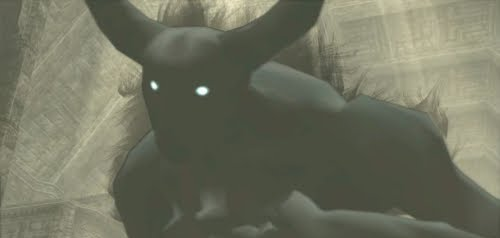
The restoration of Dormin, ironically, foreshadows more decay. Credit: Team Ico Wiki
Shadow of the Colossus is an interesting example in that the player's role in the decay-restoration cycle is not clear. Sure, Wander may be working to resurrect his love, Mono, but decay occurs all around him. The colossi, content to mind their own business, are systematically slaughtered by him, and their corresponding idols are reduced to dust. Moreover, Wander's own appearance and well-being deteriorates as he absorbs more parts of Dormin. Lastly, by reawakening Dormin, Wander produces the potential for even more degradation, as Dormin is evidently a destructive force that had to be sealed away.

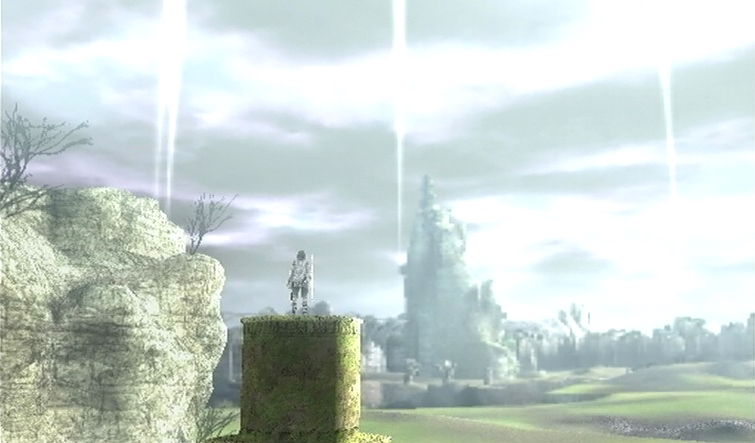
The idea of decay is also present in the Forbidden Lands themselves. As Crumplecorn notes in his analysis of Shadow of the Colossus, the various pockets of lush forest or meadow within the vast wasteland of deserts, bare plains and scrub suggest the Forbidden Lands were once a thriving natural environment. With increasing habitat fragmentation, the larger species (e.g. the deer seen in the credits sequence) would have died out, but the lizards and birds remain.

The Forbidden Lands have decayed in terms of
both biology and civilization. Credit: Team Ico Wiki
Finally, the remnants of the ancient civilization that once dwelt in the Forbidden Lands are all over the place, from the third colossus's arena in the sky to the arches in the desert to the Shrine of Worship itself. One can only wonder what caused the decay of both the natural environment and the (presumably) human population. Perhaps this was the ancestral home of Wander's and Emon's people, destroyed by Dormin and abandoned once the being was sealed away. Only Fumito Ueda will ever know. ;)