Pages

Sunday, April 27, 2014

Nazism in The Last Story

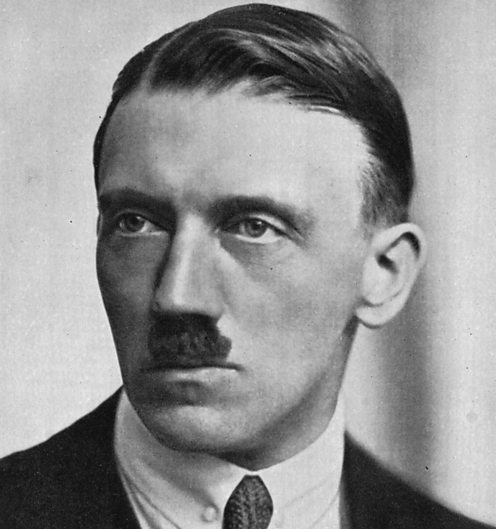
    Image result for hitler
Not so different, you and I. Zangurak picture: Behind the Voice Actors Hitler picture: BBC

The relatively harsh Treaty of Versailles forced post-World War I Germany to pay enormous reparations, cede much of its territory, and drastically decrease the size of its army. These terms, combined with all the normal costs of post-war reconstruction, left the German people eager for someone who would fix their problems, regardless of the morality of the solutions. In came Adolf Hitler and the National Socialist German Worker's Party (Nazi Party), who were all too willing to give the people what they wanted.

The story of Nazi Germany is not altogether different from the story of the Gurak in The Last Story. After losing a war with the humans, the Gurak were forced onto a harsh continent of lava and stone, a shadow of their former power. Then, Zangurak appeared, and united all the Gurak for the first time in history with his power and charisma.

Just as Hitler blamed the Jews and other groups for all of Germany's problems, Zangurak fostered hatred for the humans among his people. Hitler had his concentration camps full of Jews, gypsies, homosexuals and others, and Zangurak had his mines full of human slave workers.

This might be a bit of a stretch, but the idea of Nazi mysticism also has parallels with Zangurak's obsession with the power of the Outsider.


The banter between Zangurak and player character Zael during their final battle (Credit: YouTube user omegaevolution) sums up Zangurak's moving rhetoric and his semi-justified quest for power after years of oppression by the humans (start video around 2:30). Just as the Allies might have prevented World War II had they adopted Woodrow Wilson's policy of forgiveness, the humans might have spared many lives from both species had they worked harder to repair relations with the Gurak.

Tuesday, April 15, 2014

The Sympathetic Usurper: Zant from Twilight Princess

Yes, yes, Zant did some evil things. He usurped Princess Midna and turned her into an imp, transformed his own people into an army of vicious monsters, invaded Hyrule, and shaped it into a nether realm full of scared, lost spirits.

But can you blame him?
"The people of our tribe...were locked away in this world like insects in a cage."
The Twilight Realm was created to be a prison. Much of the Twili, including the royal family, simply didn't care about their situation anymore. Not Zant. He was a man who longed for the world of light and all its desires, excitement, and impermanence. In the constant, unchanging Twilight Realm, the only opportunity for someone like this was power.
It may be pretty, but there ain't much to do around the Twilight Realm.
Zant states that he sought power legitimately at first, and he "endured in that depraved household" for that chance. The Twili, however, were not the sort to give power lightly, and Zant's ambition scared them. Thus, his only option left was the pact he made with his "god", the Demon Thief Ganondorf.

The best comparison I can could up with was an outgoing, inquisitive child growing up in an enclosed Amish or Mennonite community. The kid longs for something he can't quite identify (Internet, fame, etc.), but his aspirations are quelled by his conservative family and friends.

Ultimately, Zant was a suppressed visionary who seized upon the first possibility of success he could find.

Saturday, April 12, 2014

Choices in KOTOR: It's the Little Things that Matter

There's a lot more to KOTOR than Sand People
genocide, although that's fun too.
Credit: Something Awful
Strategically, a Star Wars: Knights of the Old Republic (KOTOR) player should probably stick to either the light side or the dark side. However, I always find morality-based games more interesting taking the middle path (except for Bioshock 1 - I could never bring myself to murder even one Little Sister).

Thus, my Jedi Consular had a strong sense of justice, but perhaps it was too strong. Save the Wookiees from slavery? Sure. Spare the slavers? Never! Attempt to negotiate with the Sand People chief? Yes, and then commit Anakin Skywalker-style genocide upon his people when he can't guarantee peace.

By the time my party got to the Rakata world, my character distrusted the Jedi Council due to their manipulative ways, and intended to butcher Darth Malak for all the destruction he had wrought. But then, we met my sorta-girlfriend Bastila again, who seemed to have totally accepted the dark side. She offered the chance to reclaim my dark throne with a Sith babe by my side, and maybe even do some good along the way - though I'd have to keep that a secret from Basty, of course.

Bastila - Jedi Sentinel by JosephB222
Damn, Bastila, 10/10. I'd go to the dark side if this babe told me to. Left picture credit deviantART user Anglu, right picture credit deviantART user JosephB222.

So, I accepted. My companions, Juhani and Jolee, protested like the Jedi sheep they are, but when Bastila asked again, I still said I'd go with her. Then, she asked me to prove my dedication by killing Juhani and Jolee.

That's when the fog cleared. These two had been with me through thick and thin. I'd cured Juhani from the dark side and nursed back her self-confidence, and she in turn saved me from prison aboard the Leviathan. Jolee and I had bantered endlessly, and shared sad moments when he told me about his wife. I wasn't about to murder these people.
The pivotal choice in my own playthrough, though the player
in the picture, virtualcat2010, chooses rather differently. ;)
So, with shame at my previous answers, but a firm conviction as well, I forced my lover to retreat in a starfighter.

To the game system, my choices were: +Dark Side, +Dark Side, +Light Side. But to my character, it was the culmination of his struggle between justice and mercy, between power and humility. KOTOR includes many other moments like these, often in the form of dialogue choices which are functionally identical, but carry different weight and tone. I guess I just wanted to show my appreciation for KOTOR, and other BioWare games, for their understanding that there's so much more to role-playing than skill trees and binary morality systems.

Sunday, April 6, 2014

Character Analysis: Security Chief Melanie Bronson from System Shock 2

An under-appreciated badass. (Source: SHODANPEDIA)
Amid corrupt corporate executives and military officers, a hacked AI, and a psionic, parasitic annelid hivemind, Security Chief Melanie Bronson decided to f**k them all.

Bronson wasn't especially well-liked, referred to as "goddamn Bronson" by her subordinate Turnbull, and "that paranoid crank" by Yount from Ops deck. Everybody thought she was nuts, with her conspiracy theories and malfunctioning security turrets, as well as her conviction that some malignant force had infiltrated the UNN Von Braun.

Unfortunately for everyone aboard, she was right.
"Screw Anatoly, screw Diego, and screw whatever poisonous influence has desecrated this vessel... I will not abandon my post or my charge..."
 She proceeded to declare martial law on the ship, and told her men, "Anything that gets in your way, human or not, kill without pause or remorse." She demonstrated this order by executing Malick, a hacker under the influence of the aforementioned annelid hivemind (listen to the audio log below).


(Wait until the end for Bronson's badassery)
(Source: Tindeck user PsychedelicSA)

Of course, she also killed some innocent people who weren't being cooperative, but hey, they probably would have become worm-zombies anyway, right?

Bronson's actions have a huge impact on the player. Her security access doors present both a major obstacle and a reassurance that you won't have to face whatever's beyond the door until you're ready. Her turrets can also be quite a pain, but a hacking-focused character can easily use them to their advantage.

Ultimately, Bronson's incredible balls are what get her killed. Infected by the annelids, Captain Diego sends his military force of about 120, supplemented by various annelid creatures, to take out her numerically weaker security squad. A rebel to the end, her personality and awesomeness can be summarized by her final audio log:


(Source: Tindeck user PsychedelicSA)

Thursday, April 3, 2014

Lanayru Sand Sea from Skyward Sword: Bittersweet Echoes from the Past

Start from 2:54 to see the Lanayru Sand Sea in all its glory. Credit: Youtube user SasukeIII

While both Wii Zelda games were excellent in their own right, ultimately, I felt that Twilight Princess's world was built with a complexity and care that wasn't always present in Skyward Sword.

An exception, of course, is the Lanayru Sand Sea. The desert area in general had already impressed me with the Timeshift Stones - an ingenious twist to time travel mechanics - and Lanayru Mining Facility, probably the most atmospheric and unique dungeon encountered up to that point in the game. The Sand Sea, however, is in another category entirely.

When I first boarded the ship equipped with the Timeshift Stone, I was amused that the sand around it had turned to water, as it would have been in the past. As I motored along, the motion was so smooth that I didn't realize what was actually happening: the consistent radius of the Timeshift Stone allowed the boat to sail, even as the water it had passed over seconds ago caught up with time and reverted to sand.

I swore in amazement as small islands and atolls popped up all around me, and the sand dispersed to reveal bright coral and limestone rock. I was creating beauty in a desolate world, only for it to disappear moments later.

As tantalizing as Knights in the Nightmare's themes of decay and restoration are, Skyward Sword adds a melancholy slant with the fact that the restoration is only temporary. This creates a great appreciation for the splendour of the Sand Sea's harbour past, and a sadness for its loss that surpasses a standard time travel approach.

Wednesday, April 2, 2014

Knights in the Nightmare Analysis 2: Destined for Brutality

An adorable witch's last words.
Wisp, you are a heartless b*****d.
As peachy as restoring the kingdom sounds (see my last post on Knights in the Nightmare), ultimately, the Wisp is a floating ball of light devoid of any apparent personality. Yes, the game later reveals that the Wisp (spoiler alert!) is in fact King Wilmgard's soul, but this is not reflected in the dialogue. The Wisp blankly listens to things being said, offering no opinion. It can hear the souls of the kingdom's dead knights, prepare them for battle, and even sacrifice them to strengthen others, but it cannot hold a conversation with them.

The Wisp's lack of thought translates into a total lack of agency for the player. Oh, there's plenty of choice - different items to use, and knights to train - but these actions are all done for the purpose of killing. Knights takes a step back from the moral choices of Mass Effect and Bioshock, deliberately placing the player in a situation where their only power is to destroy, perhaps akin to Hotline Miami. While his subjects lauded him with praise, Wilmgard is seen as a tyrant by the Mehse and Tiamat peoples, and this aspect of his personality becomes his defining characteristic as the brutal Wisp.

Mass Effect: Terribly difficult moral choices.
Knights: See a general? KILL.
The player has two duties as the Wisp: restoring order to the kingdom as its former king, and maintaining dimensional boundaries as the divinely-appointed Arbitrator. I remember feeling this sense of purpose while playing, which added to the visceral thrill of butchering traitors and sending demons back to where they came from.

But then, the game takes a different direction: it sends the player off to the western lands in search of Wilmgard's body. Here, you encounter the disheveled, sometimes-undead Mehse people, whose lives have become defined by their oppression by Wilmgard's kingdom. The game offers no chance to make amends - instead, you must plough through every Mehse who stands in your way. During one instance in particular, the happy victory music seemed unsettlingly out-of-place as I watched a little Mehse witch I had just defeated take her final breaths. Suddenly, I didn't feel so good about my senseless slaughter of the aforementioned traitors.

The fate of the Tiamats doesn't look good either, considering they're keeping Wilmgard's own body away from him (and thus sealing their doom).

The game even taunts the player, posing scathing questions about how far they will go to take back their kingdom. These are made all the more meaningful by the fact that even in-game, the Wisp can offer no reply.

Tuesday, April 1, 2014

Knights in the Nightmare Analysis 1: Decay and Restoration

(From Destructoid)
 Often cited as an under-appreciated gem, Knights in the Nightmare turned heads with its daring combination of bullet-hell and strategy elements. Often glossed over, however, are its impeccable atmosphere and themes, which perfectly complement the gameplay. (I haven't finished the game yet, but I'm on Scene 40 of approximately 46, so I think I can give a justified opinion.) (Also, spoilers ahead.)

Richard Terrell notes the prevalence of decay in his somewhat harsh, but well-written analysis of Knights' game design. Specifically, he mentions features like weapon degradation and the gradual loss of "Time" by attacking and getting hit by enemy attacks.

Decay is also an important aspect of Knights' story. Images of King Wilmgard in all his glory are presented after certain battles, showing the king speaking with all the grace of a just ruler, and insisting to his advisers that he must see the people, and put their needs first. It is this idealized version of the past which slowly decays both as the story progresses, and as the player learns more about Wilmgard.

As Cardinal Capehorn and his allies unfurl their claws, people mysteriously disappear. Monsters attack seemingly at random. The king and his retinue are regularly sent from the castle to deal with rumours of unrest. Ultimately, Law becomes Chaos (as reflected by the phase changes in the battle system), and by the time the murdered Wilmgard reawakens as the Wisp, Aventheim Castle has been taken over by the freaking King of the Underworld, and it seems like nearly everyone is dead.
Wilmgard
Enter: King Wilmgard, Restorer of Aventheim
This is where the theme of restoration comes into play. Every scene, the player clears another area of monsters, or kills one of the bigger baddies. Each recruitment of a knight's soul is treated as a special moment, with some truly uplifting music to mark the occasion. Slowly, with the divine power of the Arbitrator, the Wisp is restoring the kingdom to its previous state, pushing away the darkness and filling it with light...

...but only up to a point. A pretty important point, I might add. While the state of the kingdom starts at rock-bottom and only improves, the player's opinion of Wilmgard starts pretty high and only decreases. This man may have been a great warrior and leader, but he was easily duped by Capehorn, and his parenting skills of Nordich leave much to be desired (spoiled brat!). Worst of all, however, is how he deals with other races, and his extremely narrow approach to diplomacy (read: violence).

More on that in my next post...