Pages

Thursday, May 29, 2014

Brutality in Bioshock Infinite

Skyhook Murder
Booker's very first kill is an astonishingly brutal one. Credit: Gameranx
Well, I recently finished Bioshock Infinite, probably one of the best games I've ever played. I enjoyed the game for many reasons, among them its commentary on violence and brutality, particularly in video games.

In the first two Bioshocks, every enemy the player faces (not the Little Sisters or Bioshock 2's still-sane inhabitants) is either a crazy, tortured drug addict, or some poor sucker bonded to a diving suit and reduced to subhuman intelligence. The weapons given to the player may inflict much pain and suffering, but the actual act of killing these enemies is quite justifiable - think of it as particularly merciless euthanization.

Bioshock Infinite also provides some put-them-out-of-their-misery enemies: the Firemen and Handymen seem to be in a great deal of pain at every passing moment. However, the vast majority of enemies are just schmucks from the Columbian army and police force, or ordinary citizens from the Vox Populi.
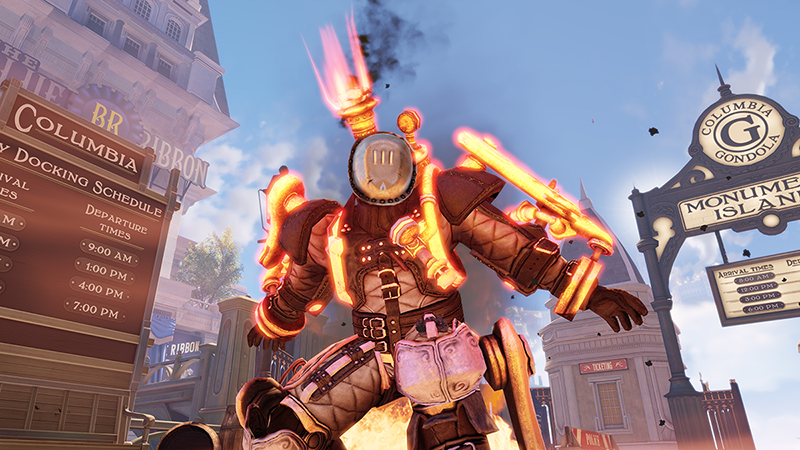
Living in a Fireman suit must be hell - Booker's probably
doing 
these guys a favour, at least. Credit: Bioshock Wiki
On the other hand, your enemies display little morality themselves; the police's first response upon your discovery is to attempt to saw your face open, and the Vox Populi's wanton destruction of Columbia reveals them to be morally lacking as well. Atlas pointed out in Bioshock 1 that Rapture isn't like the real world - barbaric violence is considered normal down there. Such is the case with Columbia - Booker and his enemies dish out violence as casually as characters in a Tarantino film.

Elizabeth at first questions Booker's actions. After an early melee with some Columbian police, Elizabeth is horrified at what Booker's done, having killed so many people. To the player, its a moment of complete surprise; they've likely been killing schmucks and not thinking twice about it. It's like the moment when your mother first realizes all the crap you've been doing in your M-rated game. Then, it's like your Mom sits down and plays that M-rated game when Elizabeth starts to procure turrets, weapons, and other offensive tools for Booker to use, (spoiler alert!) culminating in her (justified) murder of Daisy Fitzroy.

Elizabeth gets damn scary near the end of the game. Credit: Video Lithium
But then, Elizabeth comes full circle. Near the end of the game, Elizabeth asks Booker if he thinks there is any way they can possibly atone for their actions, having killed so many people. This was an interesting comment on a common trope in games: Practically speaking, it's often doubtful that the player character's end goal truly justified all their murder.

Of course, Elizabeth finds a method of redemption - one brutally efficient in and of itself. I'll talk a bit more about the ending in a later post, but it adds interesting fodder to a thought experiment someone else has no doubt conceived, but which has also occurred to me: if you torture someone and then erase their memories of it, were they ever tortured? If you cause death and destruction to the world, and then use dimension-bending powers to erase your actions from history, did they ever occur?

A reviewer once derided Infinite for attempting to criticize video game violence using video game violence, which is true enough, but the fact is, Infinite has some interesting things to say.

Sunday, May 11, 2014

Deadly Creatures: An Exercise in Point of View

Screen
Look long and hard, little scorpion... They're HUMANS. Credit: 411Mania.com
Deadly Creatures for Wii is a stunningly original title that puts players in the alternating roles of a tarantula and a scorpion. The former is an adept assassin specialized for agility and long-distance strikes, whereas the latter is a straightforward brawler skilled at powerful attacks and brutal finishing moves. The two of them each go their own way through the desert, hunting for food and killing off rival predators.

Intertwined with their individual stories, however, is the quest of two men searching for gold (played exceptionally well by Dennis Hopper and Billy Bob Thornton). The arachnids have a truly unique perspective on this tale for two reasons.

Firstly, their tiny size allows them to see what the humans can't - an especially cool sequence has the player crawling through the bones of a dead prospector, even as the ground shudders from the men's shovels hitting the soil above.
2
I"m too busy dodging horned lizard claws to care about the parallel human storyline! Credit: Destructoid
Secondly, they are totally disinterested in what's happening. Tiny arachnid brains care little for human affairs; even as the two men come closer to their goal, the tarantula remains fixed on settling a score with a certain rattlesnake, and the scorpion continues to look for a way to the surface. It's an interesting deviation from the typical first- or third-person narration techniques, in which the narrator (or player) has some clear connection to the story at hand, or is at least interested enough to document it.

However, like all good stories with parallel plotlines, the characters' tales eventually intersect, leading to an epic conclusion. Why it's epic, however, is completely different for the humans and arachnids - and while the humans may dwell on these events for the rest of their lives, the arachnids dismiss them as momentary complications, and simply return to their savage, deadly world.

Monday, April 28, 2014

Decay and Restoration in Shadow of the Colossus

I've talked about decay and restoration as gameplay and plot elements in earlier posts. Many games charge the player character with restoring a decayed world, whether that means ousting a tyrant (think of the Lord Regent from Dishonored) or returning light to a realm (dispersing the Twilight in LoZ: Twilight Princess).

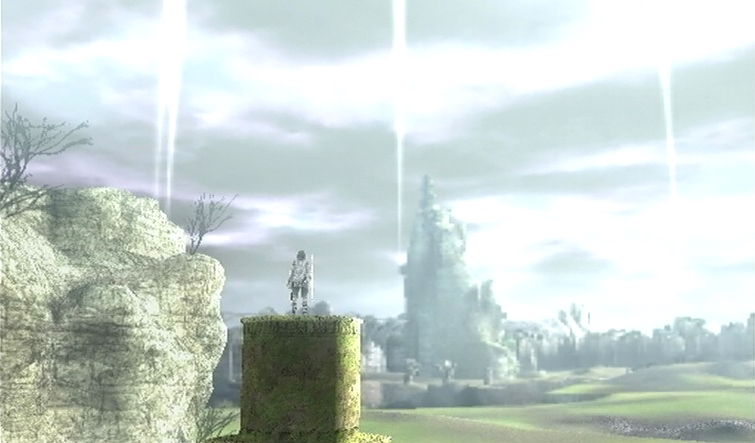
The restoration of Dormin, ironically, foreshadows more decay. Credit: Team Ico Wiki
Shadow of the Colossus is an interesting example in that the player's role in the decay-restoration cycle is not clear. Sure, Wander may be working to resurrect his love, Mono, but decay occurs all around him. The colossi, content to mind their own business, are systematically slaughtered by him, and their corresponding idols are reduced to dust. Moreover, Wander's own appearance and well-being deteriorates as he absorbs more parts of Dormin. Lastly, by reawakening Dormin, Wander produces the potential for even more degradation, as Dormin is evidently a destructive force that had to be sealed away.

The idea of decay is also present in the Forbidden Lands themselves. As Crumplecorn notes in his analysis of Shadow of the Colossus, the various pockets of lush forest or meadow within the vast wasteland of deserts, bare plains and scrub suggest the Forbidden Lands were once a thriving natural environment. With increasing habitat fragmentation, the larger species (e.g. the deer seen in the credits sequence) would have died out, but the lizards and birds remain.

The Forbidden Lands have decayed in terms of
both biology and civilization. Credit: Team Ico Wiki
Finally, the remnants of the ancient civilization that once dwelt in the Forbidden Lands are all over the place, from the third colossus's arena in the sky to the arches in the desert to the Shrine of Worship itself. One can only wonder what caused the decay of both the natural environment and the (presumably) human population. Perhaps this was the ancestral home of Wander's and Emon's people, destroyed by Dormin and abandoned once the being was sealed away. Only Fumito Ueda will ever know. ;)

Complete Devastation: Knights in the Nightmare Ending Analysis

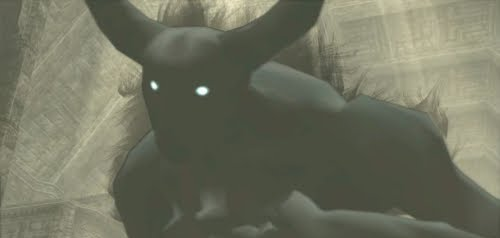
Zolgonark: an evil zombie dragon from Hell. Credit: Square Faction
I finally finished Knights in the Nightmare, and boy, the ending's a doozy. (SPOILERS, obviously.)

The whole game had been building up to Wilmgard's (the Wisp's) final confrontation with Lord Zolgonark, the King of the Underworld, who had been summoned to Earth (or whatever the realm between Asgard and the Underworld is called). The battle's pretty epic, with three heads to defeat and a demonic soul that continues to live on after the body's destruction. Just before the player reduces Zolgonark to skin and bones, however, they can use a key item on him, and he will say:
"Order is nothing but an empty world. You know this."
Keep those words in mind.

Next, Wilmgard must fight Melad Margus, the angel Melissa's form upon absorbing Zolgonark's corpse. If Wilmgard loses, the narrator declares that Margus will devastate the universe, rending it asunder with the forces of chaos. There is something hopeful about this outcome, however, for after destruction comes rebirth.

The ending the player receives upon Wilmgard's victory is much bleaker.

When Wilmgard defeats Melad Margus, has he saved the universe from destruction
or stamped out its only hope for renewal? Credit: Lacrima Castle Message Boards
Zolgonark's monsters have killed EVERYONE in the world. Seriously. There are no more knights, no more commoners, no more Tiamats, and no more Westkin. Wilmgard's soul and the angel Maria are left to wander aimlessly in the desolated land for eternity, just as Zolgonark predicted. This isn't even an Adam and Eve scenario, as Wilmgard doesn't have a body with which to repopulate the world, and Maria's a different kind of being altogether.

There is hope in the fact that Asgard (read: Heaven) still exists, but little affection can be had for its angel inhabitants, considering their lack of compassion for the suffering Tiamats and Westkin, as well as their indifference to the whole Zolgonark affair.

The finale is the culmination of all the uncertainty the player has felt the whole game; uncertainty about what's happened, why it happened, who the Wisp is, what the Wisp is doing, and most of all, if it should be doing what it is doing. Wilmgard cut down anything and anyone who stood in his way, and now he is left with nothing - a powerful conclusion to an excellent story.

Sunday, April 27, 2014

Nazism in The Last Story

    Image result for hitler
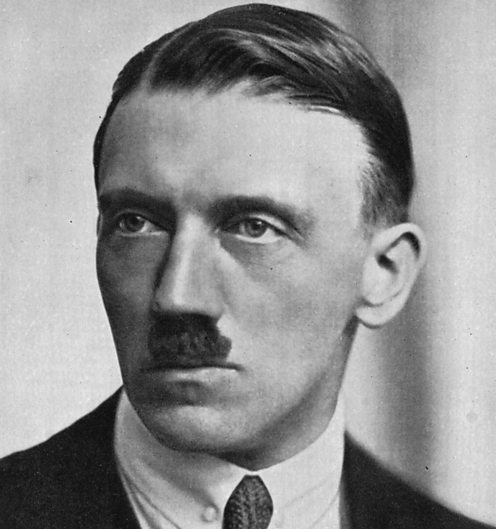
Not so different, you and I. Zangurak picture: Behind the Voice Actors Hitler picture: BBC

The relatively harsh Treaty of Versailles forced post-World War I Germany to pay enormous reparations, cede much of its territory, and drastically decrease the size of its army. These terms, combined with all the normal costs of post-war reconstruction, left the German people eager for someone who would fix their problems, regardless of the morality of the solutions. In came Adolf Hitler and the National Socialist German Worker's Party (Nazi Party), who were all too willing to give the people what they wanted.

The story of Nazi Germany is not altogether different from the story of the Gurak in The Last Story. After losing a war with the humans, the Gurak were forced onto a harsh continent of lava and stone, a shadow of their former power. Then, Zangurak appeared, and united all the Gurak for the first time in history with his power and charisma.

Just as Hitler blamed the Jews and other groups for all of Germany's problems, Zangurak fostered hatred for the humans among his people. Hitler had his concentration camps full of Jews, gypsies, homosexuals and others, and Zangurak had his mines full of human slave workers.

This might be a bit of a stretch, but the idea of Nazi mysticism also has parallels with Zangurak's obsession with the power of the Outsider.


The banter between Zangurak and player character Zael during their final battle (Credit: YouTube user omegaevolution) sums up Zangurak's moving rhetoric and his semi-justified quest for power after years of oppression by the humans (start video around 2:30). Just as the Allies might have prevented World War II had they adopted Woodrow Wilson's policy of forgiveness, the humans might have spared many lives from both species had they worked harder to repair relations with the Gurak.

Tuesday, April 15, 2014

The Sympathetic Usurper: Zant from Twilight Princess

Yes, yes, Zant did some evil things. He usurped Princess Midna and turned her into an imp, transformed his own people into an army of vicious monsters, invaded Hyrule, and shaped it into a nether realm full of scared, lost spirits.

But can you blame him?
"The people of our tribe...were locked away in this world like insects in a cage."
The Twilight Realm was created to be a prison. Much of the Twili, including the royal family, simply didn't care about their situation anymore. Not Zant. He was a man who longed for the world of light and all its desires, excitement, and impermanence. In the constant, unchanging Twilight Realm, the only opportunity for someone like this was power.
It may be pretty, but there ain't much to do around the Twilight Realm.
Zant states that he sought power legitimately at first, and he "endured in that depraved household" for that chance. The Twili, however, were not the sort to give power lightly, and Zant's ambition scared them. Thus, his only option left was the pact he made with his "god", the Demon Thief Ganondorf.

The best comparison I can could up with was an outgoing, inquisitive child growing up in an enclosed Amish or Mennonite community. The kid longs for something he can't quite identify (Internet, fame, etc.), but his aspirations are quelled by his conservative family and friends.

Ultimately, Zant was a suppressed visionary who seized upon the first possibility of success he could find.

Saturday, April 12, 2014

Choices in KOTOR: It's the Little Things that Matter

There's a lot more to KOTOR than Sand People
genocide, although that's fun too.
Credit: Something Awful
Strategically, a Star Wars: Knights of the Old Republic (KOTOR) player should probably stick to either the light side or the dark side. However, I always find morality-based games more interesting taking the middle path (except for Bioshock 1 - I could never bring myself to murder even one Little Sister).

Thus, my Jedi Consular had a strong sense of justice, but perhaps it was too strong. Save the Wookiees from slavery? Sure. Spare the slavers? Never! Attempt to negotiate with the Sand People chief? Yes, and then commit Anakin Skywalker-style genocide upon his people when he can't guarantee peace.

By the time my party got to the Rakata world, my character distrusted the Jedi Council due to their manipulative ways, and intended to butcher Darth Malak for all the destruction he had wrought. But then, we met my sorta-girlfriend Bastila again, who seemed to have totally accepted the dark side. She offered the chance to reclaim my dark throne with a Sith babe by my side, and maybe even do some good along the way - though I'd have to keep that a secret from Basty, of course.

Bastila - Jedi Sentinel by JosephB222
Damn, Bastila, 10/10. I'd go to the dark side if this babe told me to. Left picture credit deviantART user Anglu, right picture credit deviantART user JosephB222.

So, I accepted. My companions, Juhani and Jolee, protested like the Jedi sheep they are, but when Bastila asked again, I still said I'd go with her. Then, she asked me to prove my dedication by killing Juhani and Jolee.

That's when the fog cleared. These two had been with me through thick and thin. I'd cured Juhani from the dark side and nursed back her self-confidence, and she in turn saved me from prison aboard the Leviathan. Jolee and I had bantered endlessly, and shared sad moments when he told me about his wife. I wasn't about to murder these people.
The pivotal choice in my own playthrough, though the player
in the picture, virtualcat2010, chooses rather differently. ;)
So, with shame at my previous answers, but a firm conviction as well, I forced my lover to retreat in a starfighter.

To the game system, my choices were: +Dark Side, +Dark Side, +Light Side. But to my character, it was the culmination of his struggle between justice and mercy, between power and humility. KOTOR includes many other moments like these, often in the form of dialogue choices which are functionally identical, but carry different weight and tone. I guess I just wanted to show my appreciation for KOTOR, and other BioWare games, for their understanding that there's so much more to role-playing than skill trees and binary morality systems.